Artificial Intelligence
Artificial Intelligence
"Artificial intelligence (AI) means the simulation of human intelligence by machines or virtual assistants that are programmed to think and behave like humans and mimic their actions". AI can also be applied to any machine that shows traits that resemble a human mind such as learning and problem-solving. Artificial Intelligence (AI) is intelligence proved by machines. AI today includes the sub-fields of machine learning and deep learning, which are frequently mentioned in conjunction with artificial intelligence. These disciplines are comprised of AI algorithms that typically make predictions or classifications based on input data. Machine learning has improved the quality of some expert systems and made it easier to create them.

There is a lot of hype about AI development, which is to be expected of any emerging technology. As noted in Gartner’s hype cycle product innovations like self-driving cars and personal assistants follow “a typical progression of innovation, from overenthusiasm through a period of disillusionment to an eventual understanding of the innovation’s relevance and role in a market or domain.” As Lex Fridman notes in his 2019 MIT lecture, we are at the peak of inflated expectations, approaching the trough of disillusionment.
Developers use artificial intelligence to more efficiently perform tasks that are otherwise done manually, connect with customers, identify patterns, and solve problems. To get started with AI, developers should have a background in mathematics and feel comfortable with algorithms. When getting started with using artificial intelligence to build an application, it helps to start small. By building a relatively simple project, such as tic-tac-toe, for example, you’ll learn the basics of artificial intelligence. Learning by doing is a great way to level-up any skill, and artificial intelligence is no different. Once you’ve successfully completed one or more small-scale projects, there are no limits for where artificial intelligence can take you.
Types of artificial intelligence:
Based on Capabilities:
1. Weak AI—also called Narrow AI or Artificial Narrow Intelligence (ANI)—is AI trained to perform specific tasks. Weak AI drives most of the AI that surrounds us today. ‘Narrow’ might be a more accurate descriptor for this type of AI as it is anything but weak; it enables some powerful applications, such as Apple's Siri, Amazon's Alexa, IBM Watson, and autonomous vehicles.
2. Strong AI is made up of Artificial General Intelligence (AGI) and Artificial Super Intelligence (ASI). Artificial General Intelligence (AGI), or general AI, is a theoretical form of AI where a machine would have an intelligence equal to humans; it would have a self-aware consciousness that has the ability to solve problems, learn, and plan for the future. Artificial Super Intelligence (ASI)—also known as superintelligence—would surpass the intelligence and ability of the human brain. While strong AI is still entirely theoretical with no practical examples in use today, AI researchers are exploring its development.
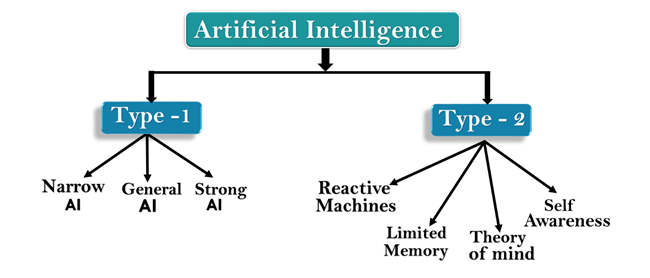
Based on functionality:
1. The reactive machine type is the most basic variety of AI. It merely reacts to current scenarios and cannot rely on upon taught or recalled data to make decisions in the present. Reactive machines do away with maps and other forms of pre-planning altogether and focus on live observations of the environment. They are given specific tasks and don’t have capabilities beyond those duties. They’re what you’re most likely to see when witnessing a robot playing a game, like chess, against a human. But reactive machines don’t interact with the world, so they respond to identical situations in the same ways every time those scenarios are encountered.
2. Limited memory is a type of artificial intelligence. It refers to an AI’s ability to store previous data and predictions, using that data to make better predictions. With limited memory, ML architecture becomes a little more complex. Every ML model requires limited memory to be created, but the model can get deployed as a reactive machine type, which is the most basic and simplest type of AI.
3. Theory of Mind AI should understand the human emotions, people, beliefs, and be able to interact socially like humans. This type of AI machines is still not developed, but researchers are making lots of efforts and improvement for developing such AI machines.
4. Self-awareness AI is the future of Artificial Intelligence. These machines will be super intelligent, and will have their own consciousness, sentiments, and self-awareness. These machines will be smarter than human mind. Self-Awareness AI does not exist in reality still and it is a hypothetical concept.
Advantages of Artificial Intelligence:
1.
AI completes routine tasks with ease.
Many of the tasks that we completea day are repetitive. That repetition helps usto urge into a routine and positive workflow. It also takes upplenty of our time. With AI, the repetitive tasksare often automated, finely tuning the equipmentto figure for extended time periods to complete the work.that permits human workers to focus on the more creative elements of their job responsibilities.
2.
AI can work indefinitely.
Human workers are typically good for 8-10 hours of productiona day.AI can continue operating for an indefinite time period. As long asthere's a power resource available to it,and therefore the equipment is properly cared for, AI machinesdon't experience the same dips in productivity that human workers experience when they get tired at the end of the day.
3.
AI makes fewer errors.
AIis vital within certain fields and industries where accuracy or precision is the top priority. When thereare not any margins for error, these machines areready to breakdown complicated math constructs into practical actions faster, and with more accuracy,in comparison to human workers.
4.
AI helps us to explore.
There are many places in our universe whereit might be unsafe, if not impossible, for humansto work out. AI makes it possible for usto find out more about these places, which furthers our species knowledge database.we will explore the deepest parts of the ocean because of AI.we will journey to inhospitable planets because of AI.we will even find new resources to consume because of this technology.
5.
AI makes us become more productive.
AI createsa replacement standard for productivity.it'll also make each one of us more productive as well. Ifyou're texting someone or using word processing software to write a report and a misspelled word is automatically corrected, then you’ve just experienced a time benefitdue to AI.a man-made intelligence can sift through petabytes of information, whichare some things the human brain is just not designed to do.
6.
AI could make us healthier.
Every industry benefit from the presence and use of AI.we will use AI to establish healthier eating habits or to get more exercise. Itis often used to diagnose certain diseases or recommends a treatment plan for something already diagnosed.within the future, AI might even assist physicians who are conducting a surgery.
Disadvantages of Artificial Intelligence:
1.
AI comes with a steep price tag.
A new artificial intelligence is costly to build. Althoughthe worth is coming down, individual developments can still be as high as $300,000 for a basic AI.for little businesses operating on tight margins or low initial capital,it's going to be difficult to find the cash necessary to take advantage of the benefits which AI can bring. For larger companies,the value of AI may be much higher, depending upon the scope of the project.
2.
AI will reduce employment opportunities.
There will be jobs gained because of AI.there'll also be jobs lost because of it. Any job which features repetitive tasks asa part of its duties is at-risk of being replaced by an artificial intelligence in the future. In 2017, Gartner predicted that 500,000 net jobs would be createddue to AI. Onthe opposite end of the spectrum, up to 900,000 jobsmight be lost because of it. Those figures are for jobs only within the us.
3.
AI will be tasked with its own decisions.
One of the greatest threats we face with AI is its decision-making mechanism. An AIis merely as intelligent and insightful as the individuals responsible for its initial programming.meaning there could be a certain bias found within is mechanisms when it is time to make an important decision. In 2014,a lively shooter situation caused people to call Uber to escape the area.rather than recognizing the dangerous situation, the algorithm Uber used saw a spike in demand, so it decidedto extend prices.
4.
AI lacks creativity.
We can program robots to perform creative tasks. Where we stallcall at the evolution of AI is creating an intelligence which can be originally creative on its own. Our current AI matches the creativity of its creator. Becausethere's a lack of creativity, there tends to bea scarcity of empathy as well.meaning the decision of an AI is based on what the best possible analytical solution happens to be,which cannot always be the correct decision to make.
5.
AI can lack improvement.
An artificial intelligence may be able to change how it reacts in certain situations,very similar to a child stop touching a hot stove after being burned by it. What itdoesn't do is alter its perceptions, responses, or reactions whenthere's a changing environment.there's an inability to distinguish specific bits of information observed beyond the data generated by that direct observation.
6.
AI can be inaccurate.
Machine translationsbecame an important tool in our quest to communicate with one another universally.the sole problem with these translations is that they must be reviewed by humans because the words, not the intent of the words, is what machines translate. Without a review by a trained human translator,the knowledge received from a machine translation may be inaccurate or insensitive, creating more problemsrather than fewer with our overall communication.

These AI pros and cons show us that our world can benefit from its presence in a variety of ways. Therealso are many potential dangers which come with this technology. Jobscould also be created, but jobsare going to be lost. Livesmight be saved, but lives couldeven be lost.that's why the technologies behind AI must be made available to everyone. If onlysome hold the power of AI, thenthe planet could become a very different place in a short period of time.
- BY GOWTHAM VARMA
This blog give's a clear idea about pro and cons of AI which is very usefull for those fellow who are thinking about the scope of AI in future.TQ Gowtham for putting such effect.
ReplyDeleteCreative 👌👌
ReplyDeleteThis is very useful information about AI and also it tells about the positives and negatives of using AI in the future and hats off for the great creation
ReplyDeleteGreat work
ReplyDeleteGood work
ReplyDeleteThe information on Ai very nice and simply
ReplyDelete